Representative Image

ISOLAB Laborgeräte General Use Scissors, 130 mm, Straight

Brand:ISOLAB

Overall length

Version

Specifications

Compare models
HS Code #
82130000
Material
Stainless steel
Overall length
130 mm
UNSPSC
41122408
Version
Straight

Alternative in-stock items

SG $7.41

Inc. GST

Available soon

Product description

The ISOLAB Laborgeräte General Use Scissors are designed for versatile cutting tasks in laboratory and general settings. Measuring 130 mm in length, these straight scissors offer precision and control for various applications. Constructed from high-quality stainless steel, they ensure durability and resistance to corrosion, making them suitable for both laboratory and everyday use. The ergonomic design provides comfort during extended use, enhancing efficiency and safety.

Key Features:

  • Brand: ISOLAB Laborgeräte
  • Type: General Use Scissors
  • Length: 130 mm
  • Blade Design: Straight
  • Material: High-quality stainless steel
  • Ease Of Use: Ergonomic handle for comfort
  • Application: Suitable for laboratory and general use

The ISOLAB Laborgeräte General Use Scissors are essential tools in both laboratory and everyday environments, offering reliable performance for a variety of cutting tasks. Their durable construction and ergonomic design make them a preferred choice for professionals seeking quality and comfort in their tools.

Compare similar models

Scissors 130 mm, straight general use

Manufacturer P/N

048.30.130

Part Number

4.008 515

Manufacturer

ISOLAB

Overall length

130 mm

Scissors 160 mm, straight general use

Manufacturer P/N

048.30.160

Part Number

4.008 516

Manufacturer

ISOLAB

Overall length

160 mm

Scissors 200 mm, curved general use

Manufacturer P/N

048.30.200

Part Number

4.008 517

Manufacturer

ISOLAB

Overall length

200 mm

Frequently asked questions

It are designed for versatile cutting tasks in laboratory and general settings. Measuring 130 mm in length, these straight scissors offer precision and control for various applications. Constructed from high-quality stainless steel, they ensure durability and resistance to corrosion, making them suitable for both laboratory and everyday use. The ergonomic design provides comfort during extended use, enhancing efficiency and safety.

Insights

Explore
Cleaning Lab Glassware: Removing Stubborn Residue

7 mins read

Cleaning Lab Glassware: Removing Stubborn Residue

Cleaning laboratory glassware properly is essential for accurate, safe, and repeatable lab work. This guide explains how to remove stubborn residue from beakers, flasks, bottles, volumetric glassware, and other lab glassware, including grease, dried salts, biological residue, stains, and burnt deposits. It also covers safe cleaning methods, common mistakes, drying and storage tips, and when damaged glassware should be replaced.
Read full story
How to Calibrate Your Pipettes to ISO 8655 Standards

7 mins read

How to Calibrate Your Pipettes to ISO 8655 Standards

Pipette calibration helps laboratories confirm that liquid handling results remain accurate, repeatable, and traceable. This guide explains how pipettes are calibrated to ISO 8655 standards, including gravimetric testing, environmental control, correct tip selection, volume testing, calibration records, and common mistakes to avoid. It also covers when to use in-house calibration and when an external calibration service may be more suitable.

Read full story
Molarity and Dilution Calculator

9 mins read

Molarity and Dilution Calculator

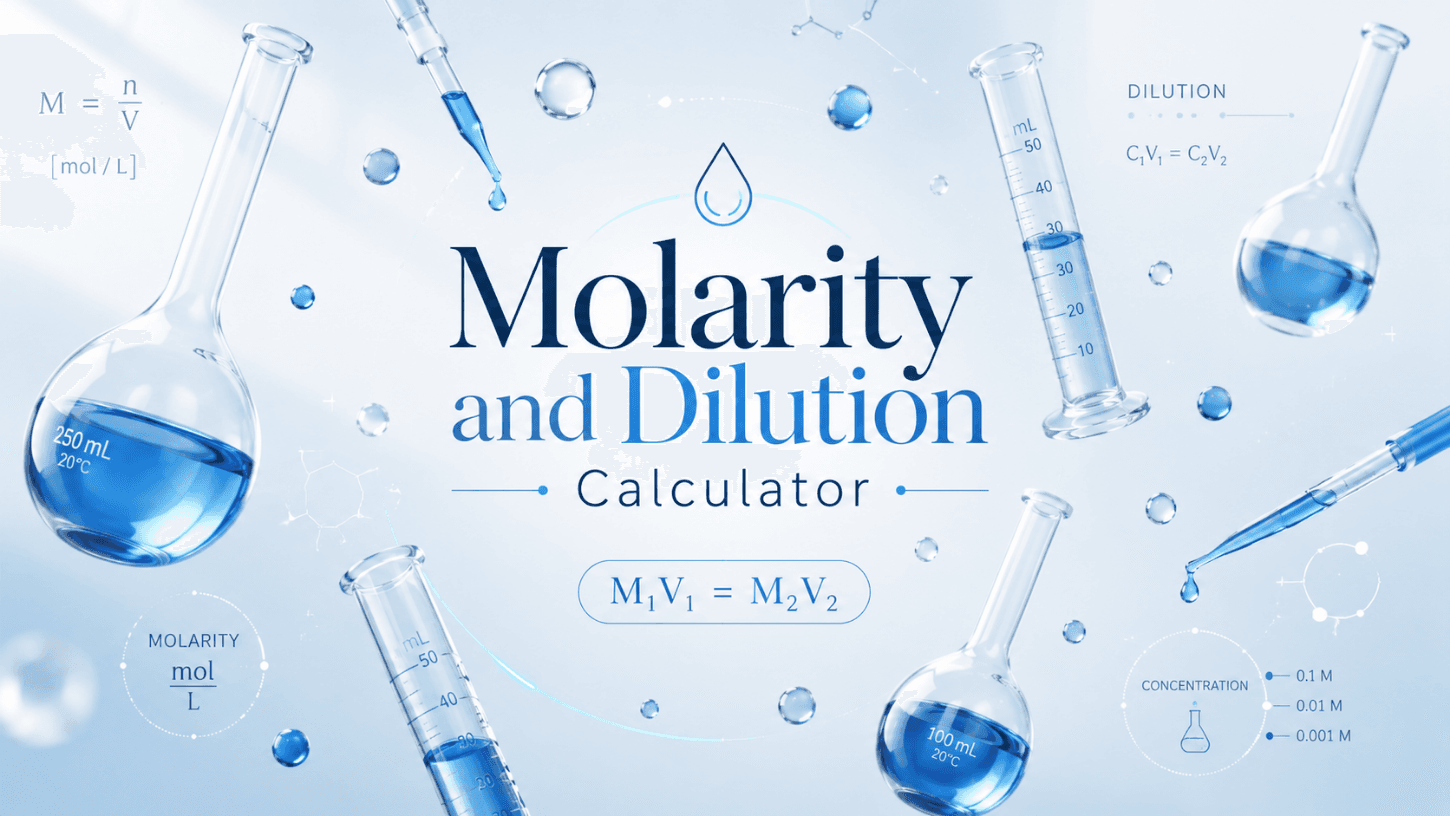
A free molarity and dilution calculator covering four essential lab calculations: C1V1=C2V2 dilution (solve for any unknown), molarity from mass, mass from molarity, and serial dilution table generation. Includes worked examples, a concentration units guide and step-by-step preparation instructions for every result.

Read full story
Buffer Preparation Calculator

9 mins read

Buffer Preparation Calculator

Free online buffer preparation calculator. Select your buffer system, enter target pH, concentration and volume, and get an exact lab-ready recipe with reagent masses and step-by-step instructions. Covers PBS, Tris-HCl, sodium phosphate, acetate, HEPES, MOPS and more.

Read full story