Representative Image

MOTIC Microscope RED120 with 4X, 10X, and 40X Objective Lens

Brand:Motic

Specifications

HS Code #
90118000
Condenser
Abbe 1,25
Depth
234 mm
Dimensions (WxDxH)
152 x 234 x 334 mm
Height
334 mm
Inclination angle tube
45°
Magnification objectives
4x, 10x, 40x
Max. voltage
240 V
Min. voltage
100 V
Power supply
100 ... 240 V
Revolving nosepiece
4-fold

SG $750.46

Inc. GST

Available soon

Product description

The MOTIC Microscope RED120 is a high-quality optical instrument designed for educational and laboratory use. With 4X, 10X, and 40X objective lenses, this microscope provides clear and sharp imaging for detailed specimen observation. Its durable construction ensures long-term reliability, making it a great choice for students, teachers, and researchers.

Key Features:

  • Brand: MOTIC
  • Swivelling Head: Monocular head 45°, 360° rotating
  • Nosepiece: Reversed quadruple revolving nosepiece
  • Focusing System: Separate coarse and fine focusing system
  • Mechanical Stage: Built-in low position coaxial mechanical stage
  • Condenser: 1.25 N.A. Abbe condenser with iris diaphragm
  • Objective lenses: 4X, 10X, and 40X magnifications
  • Image Resolution: Clear optics for high-resolution imaging
  • Design: Sturdy and durable design for daily use
  • Application: Ideal for education and research applications

Scope of Supply:

  • Microscope
  • Dust cover
  • Charger
  • Rechargeable batteries

The MOTIC RED120 microscope is an excellent choice for those who require reliable, high-quality optical performance in an educational or laboratory setting.

More items to explore

Educational microscopes, RED 100

ProductTypeType of auxiliary energyMfr#Part#AvailabilityPrice
RED 100Mains connection11001029000226.285 856SG $587.40

Educational microscopes, RED 130

ProductLight typeTypeMfr#Part#AvailabilityPrice
LEDRED 13011001029003726.281 647SG $928.35
LEDRED 13011001029003764.685 579SG $813.47

Frequently asked questions

It is a high-quality optical instrument designed for educational and laboratory use. With 4X, 10X, and 40X objective lenses, this microscope provides clear and sharp imaging for detailed specimen observation. Its durable construction ensures long-term reliability, making it a great choice for students, teachers, and researchers.

Insights

Explore
Cleaning Lab Glassware: Removing Stubborn Residue

7 mins read

Cleaning Lab Glassware: Removing Stubborn Residue

Cleaning laboratory glassware properly is essential for accurate, safe, and repeatable lab work. This guide explains how to remove stubborn residue from beakers, flasks, bottles, volumetric glassware, and other lab glassware, including grease, dried salts, biological residue, stains, and burnt deposits. It also covers safe cleaning methods, common mistakes, drying and storage tips, and when damaged glassware should be replaced.
Read full story
How to Calibrate Your Pipettes to ISO 8655 Standards

7 mins read

How to Calibrate Your Pipettes to ISO 8655 Standards

Pipette calibration helps laboratories confirm that liquid handling results remain accurate, repeatable, and traceable. This guide explains how pipettes are calibrated to ISO 8655 standards, including gravimetric testing, environmental control, correct tip selection, volume testing, calibration records, and common mistakes to avoid. It also covers when to use in-house calibration and when an external calibration service may be more suitable.

Read full story
Molarity and Dilution Calculator

9 mins read

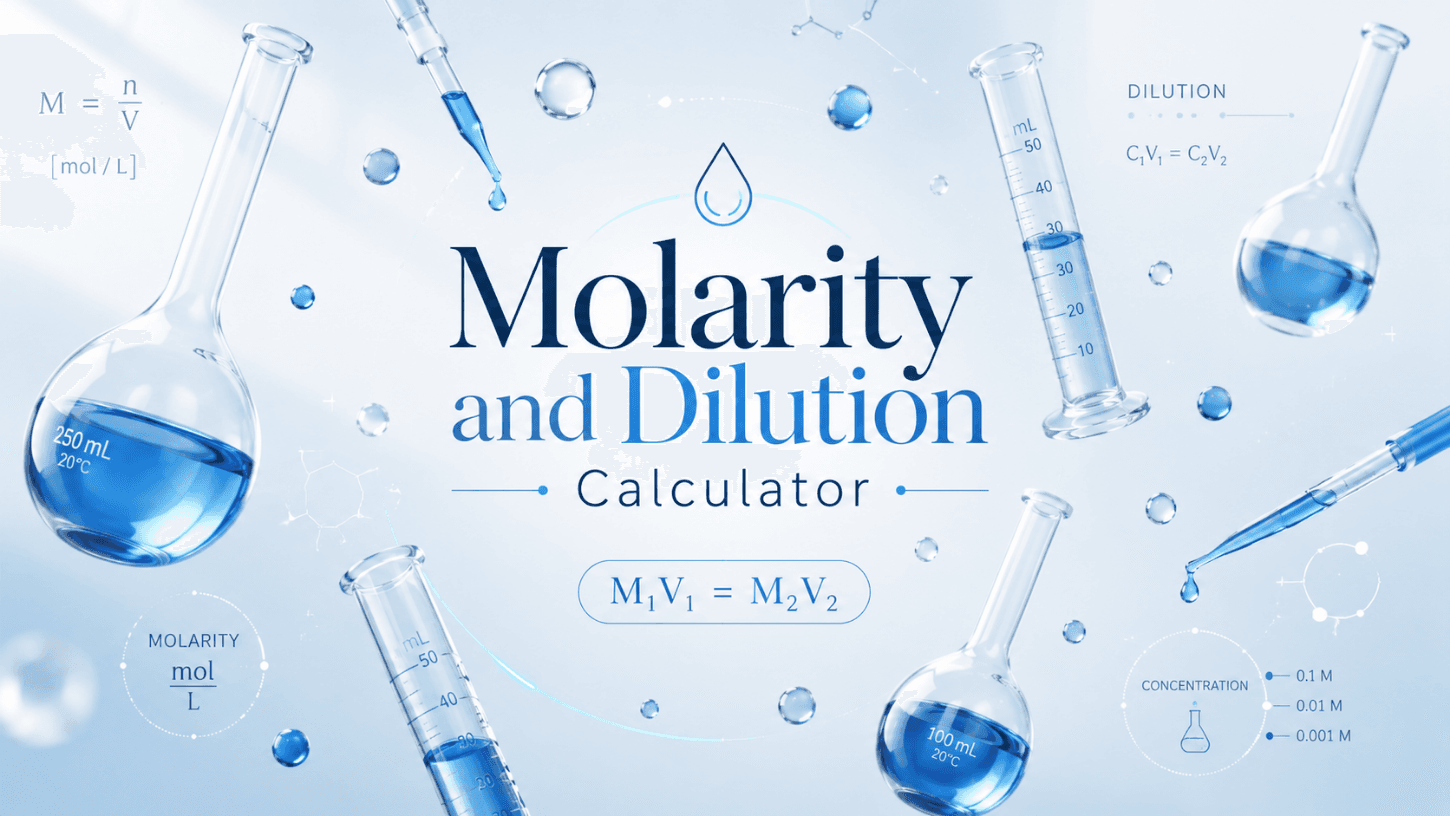
Molarity and Dilution Calculator

A free molarity and dilution calculator covering four essential lab calculations: C1V1=C2V2 dilution (solve for any unknown), molarity from mass, mass from molarity, and serial dilution table generation. Includes worked examples, a concentration units guide and step-by-step preparation instructions for every result.

Read full story
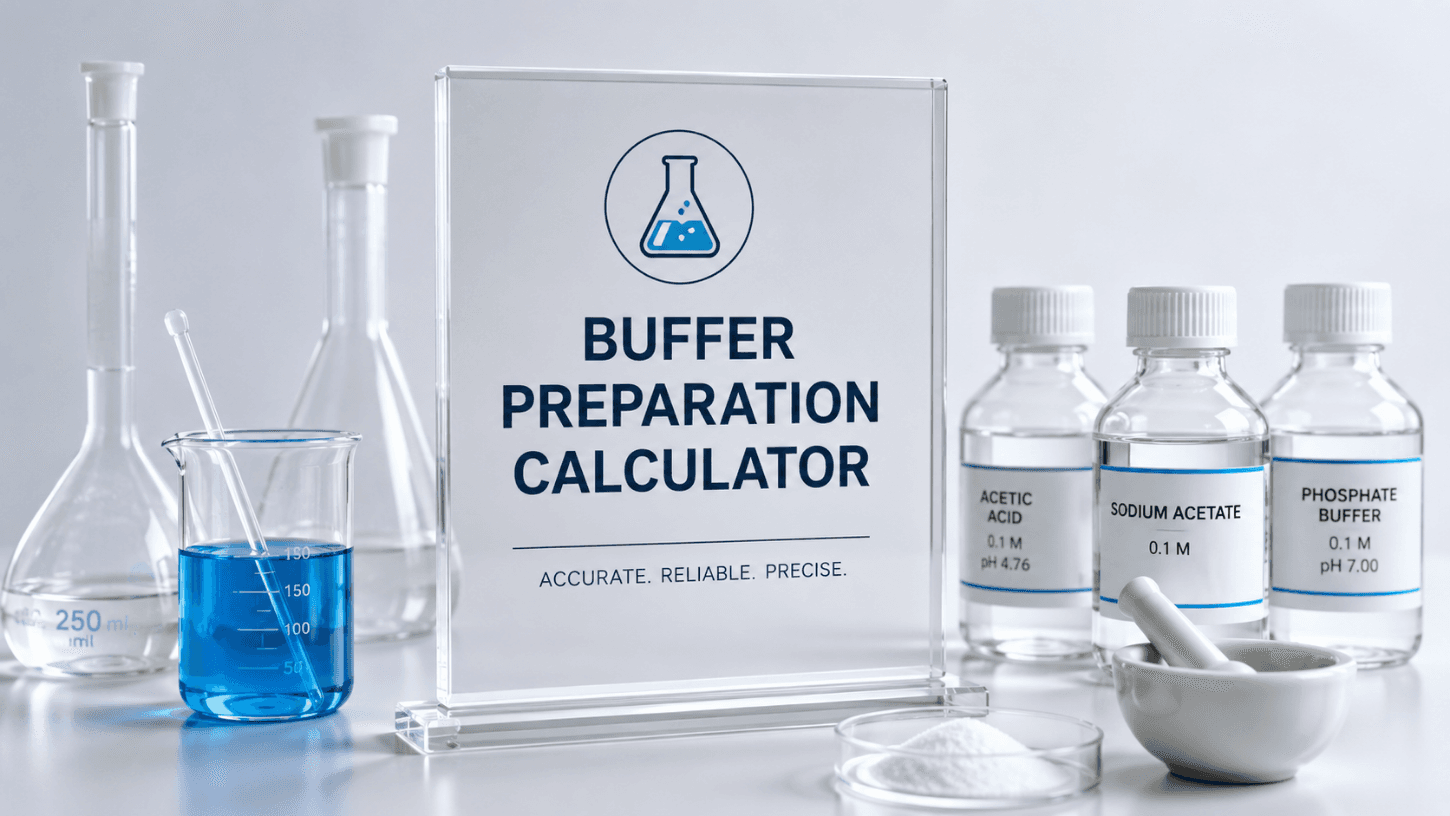
Buffer Preparation Calculator

9 mins read

Buffer Preparation Calculator

Free online buffer preparation calculator. Select your buffer system, enter target pH, concentration and volume, and get an exact lab-ready recipe with reagent masses and step-by-step instructions. Covers PBS, Tris-HCl, sodium phosphate, acetate, HEPES, MOPS and more.

Read full story